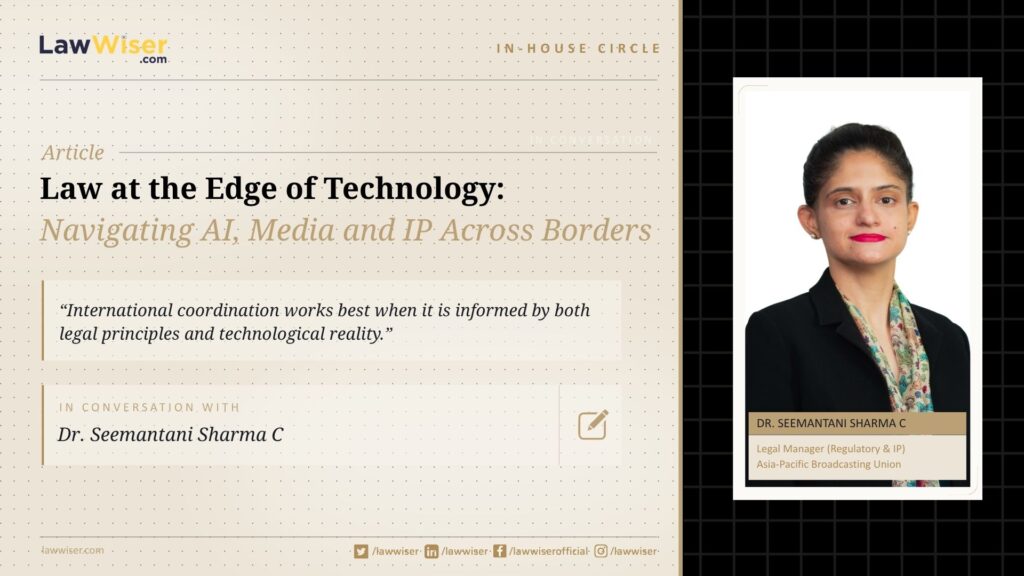
Law at the Edge of Technology: Navigating AI, Media and IP Across Borders
You’ve worked at the intersection of law, technology, media and international policy. What about this intersection continues to excite you as a lawyer?
What continues to excite me about this intersection is that it is constantly changing. I don’t think you ever reach a point where you can say, “I’ve understood this area and I’m done.”
I’ve worked across commercial law, intellectual property, media and technology, and increasingly the interesting questions sit precisely at the boundaries between those areas. A technological development can create a contractual issue, an IP issue, a regulatory issue and sometimes even a policy question at the same time.
Working in an international broadcasting organisation has made that particularly apparent to me. A question that initially looks like a straightforward content or licensing issue can quickly involve copyright, performers’ rights, territorial rights, data, technology platforms and different regulatory environments across countries. Because ABU works across multiple jurisdictions and with public-service and commercial broadcasters, you also have to think about whether a legal solution is actually workable for organisations operating in very different legal and technological environments.
My work with international IP and policy discussions has reinforced that perspective. I’ve seen how a question that looks quite technical from a legal standpoint can have very different implications for creators, broadcasters, technology companies and policymakers.
I’ve also had the opportunity to advise, at a strategic level, an early-stage clean-tech venture developing technology around more efficient cooling and HVAC services. At that stage, there isn’t necessarily a mature commercial product or a large legal department waiting for advice. The challenge is to think ahead: what intellectual property needs to be protected, what relationships need to be documented, what data and technology issues might arise, and what legal architecture will still make sense when the business eventually scales.
What has changed for me as technology has evolved is that I increasingly see the lawyer’s role as moving beyond simply asking, “What does the law say?” We also have to ask, “What is the technology actually doing, where are the risks arising, and how can the legal framework respond in a way that is commercially and technologically realistic?”
AI has made that even more apparent. The technology is developing very quickly, while legislation, case law and international policy frameworks inevitably take longer. So I think adaptability and technological literacy are becoming core legal skills.
For me, that is actually what makes this area exciting. The law is not operating in isolation. It is interacting with technological innovation, business models, creativity and international policy in real time.
How is AI changing the role of the international in-house lawyer, particularly when legal teams deal with technologies that evolve faster than the law?
AI is changing the role of the international in-house lawyer in a fairly fundamental way because the lawyer is increasingly dealing with technologies where there may not yet be a settled legal answer.
Traditionally, you might receive a question, identify the applicable law, assess the risk and give advice. With emerging technologies, the first question may actually be: “What is this system doing?”
I’ve experienced that quite directly in my work around AI and media. In developing internal legal guidance and research around AI for a broadcasting organisation, one of the first things I found was that simply saying “AI is legally risky” isn’t particularly useful. You have to break the question down. What is the organisation using the system for? What data is involved? Is the system generating content? Is confidential information being entered? What intellectual property rights are potentially implicated? Who is responsible for reviewing the output?
That changes the nature of the legal advice. Instead of giving the organisation a single yes-or-no answer, you are building a framework that allows people to make informed decisions across different use cases.
There is also a significant international dimension. AI systems, data, intellectual property and digital services don’t respect national borders. You may have one jurisdiction where a particular use is permitted, another where there are restrictions, and a third where the legal position is still developing.
My experience working with international organisations and policy discussions has made me particularly conscious of that problem. The lawyer increasingly has to understand not just the law in one jurisdiction, but where different legal systems are converging and where they are diverging.
My work with an early-stage technology venture has given me another perspective. When you’re advising a technology business before it has fully commercialised, you have to think about legal architecture before all the facts are known. You are essentially asking: if this technology develops in the way we expect, what legal and IP structures will we need later?
That means the international in-house lawyer increasingly has to think in terms of legal architecture rather than isolated legal questions: what principles are stable across jurisdictions, where are the material differences, and how do we build a framework that can actually work for the organisation?
I think the role is therefore becoming less about being the person who simply says “yes” or “no”, and more about helping the organisation understand how to innovate responsibly within uncertainty.
You’ve spoken about the need for lawyers to understand technology rather than simply regulate it. Why do you think that shift if becoming so important when it comes to AI governance?
I think the biggest reason is very simple: you cannot govern what you do not understand.
That doesn’t mean every lawyer needs to become an engineer. But if we are advising on AI, we need to understand enough about how the technology works to identify where the actual legal and governance issues arise.
I’ve seen this in practice. When I work on technology-related questions, I don’t want to start with a legal category and then try to force the technology into it. I prefer to start with the use case: what is the system actually doing, what information is going into it, what does it produce, who interacts with it, and where does it sit within the organisation’s workflow?
Only then can you properly map the law onto it.
For example, with generative AI, it matters whether we are talking about training data, model outputs, personal data, provenance, attribution, licensing, or the deployment of the system in a particular business context. Those are quite different questions.
If a lawyer approaches all of them simply as “AI regulation”, the advice can become very abstract.
My experience developing AI-related legal guidance within a media organisation reinforced that for me. The most useful legal advice isn’t necessarily the longest legal memorandum. It can be a framework that helps people identify the relevant questions before they adopt a technology or use it in a particular way.
I’ve also found the same principle useful when advising an early-stage clean-tech venture. At an early stage, the lawyer has an opportunity to ask the questions before commercial structures become fixed: what is the actual technology, where is the intellectual property, what data is being generated, who needs access to it, and what should be protected or documented as the venture develops?
So I think the more useful approach is to understand the technology first and then map the law onto the actual use case.
That also changes the relationship between lawyers and technologists. Instead of lawyers arriving at the end of the process and saying, “You cannot do this,” we can become involved earlier and help design systems and processes that are legally robust from the beginning.
For me, that is a much more constructive model of technology governance.
Turning to media and broadcasting, AI is bringing up some fascinating questions around copyright, synthetic media and AI-generated content. What are the key issues you think the industry needs to consider right now?
I think the media industry is facing several questions simultaneously, and copyright is only one part of the picture.
The first is the use of copyrighted material in developing or training AI systems. There are questions around what rights are implicated, what permissions may be required, and how different jurisdictions approach those issues.
Then you have the output side: who owns or controls AI-generated material, what level of human contribution is required for copyright protection, and how do we deal with attribution and provenance?
My own academic work on performers’ rights has also made me particularly conscious that copyright isn’t the only rights framework relevant to media and emerging technologies. A performance involves interests that can be distinct from ownership of the underlying copyright. That becomes particularly interesting when technology can reproduce, manipulate or transform aspects of a person’s performance or identity.
Synthetic media introduces another layer. Broadcasters have to think not only about copyright, but also about authenticity, consent, personality rights, performers’ rights, reputational harm and the ability of audiences to distinguish genuine material from synthetic material.
From the broadcasting perspective, there is also a very practical dimension. Media organisations need to understand what rights they are acquiring when they use AI tools, what rights they may be granting to those tools, and what happens to confidential or proprietary content that enters an AI system.
That is why I think the industry needs to move away from treating AI simply as a compliance issue. It is also a rights-management issue, a contractual issue and increasingly a content-governance issue.
And in broadcasting, I think provenance and trust may become just as important as the question of who owns the underlying content. If an organisation cannot establish where content came from, what was done to it, and what rights attach to it, the legal problem can quickly become an editorial and reputational problem as well.
So for me, the really interesting question isn’t simply “Who owns AI-generated content?” It is “What combination of rights, permissions, provenance and accountability do we need to make AI-enabled media trustworthy and legally sustainable?”
Finally, as AI and emerging technologies become increasingly global, how do you see IP strategy evolving across jurisdictions? And from your experience working with international organisations and policymakers, what role can lawyers play in shaping this global conversation?
I think IP strategy is becoming more strategic and more international at the same time.
Historically, organisations could often think about IP rights jurisdiction by jurisdiction. But with digital technologies and AI, the same technology or content can be developed in one country, trained or processed across several jurisdictions, and distributed globally.
So the challenge is not simply asking, “What is the law in each country?” It is understanding where the important points of legal divergence are and designing an IP strategy around them.
That is where lawyers working with international organisations and policymakers can play an important role. We can help translate between different legal systems, but also between different communities — industry, creators, governments, technology developers and international organisations.
And yes, I do think greater international coordination is becoming necessary. It doesn’t necessarily mean that every country needs identical legislation. That may not even be realistic.
But there is significant value in developing common principles, terminology and approaches to issues such as AI-generated content, training data, provenance, copyright and enforcement.
From my perspective, international coordination works best when it is informed by both legal principles and technological reality. The objective should be to create frameworks that are sufficiently coherent internationally while still allowing room for innovation and different national approaches.
I think that is one of the most interesting roles for lawyers in this space: not simply interpreting the law after it has developed, but contributing to the conversations that help shape how the law develops.