

 April 23, 2026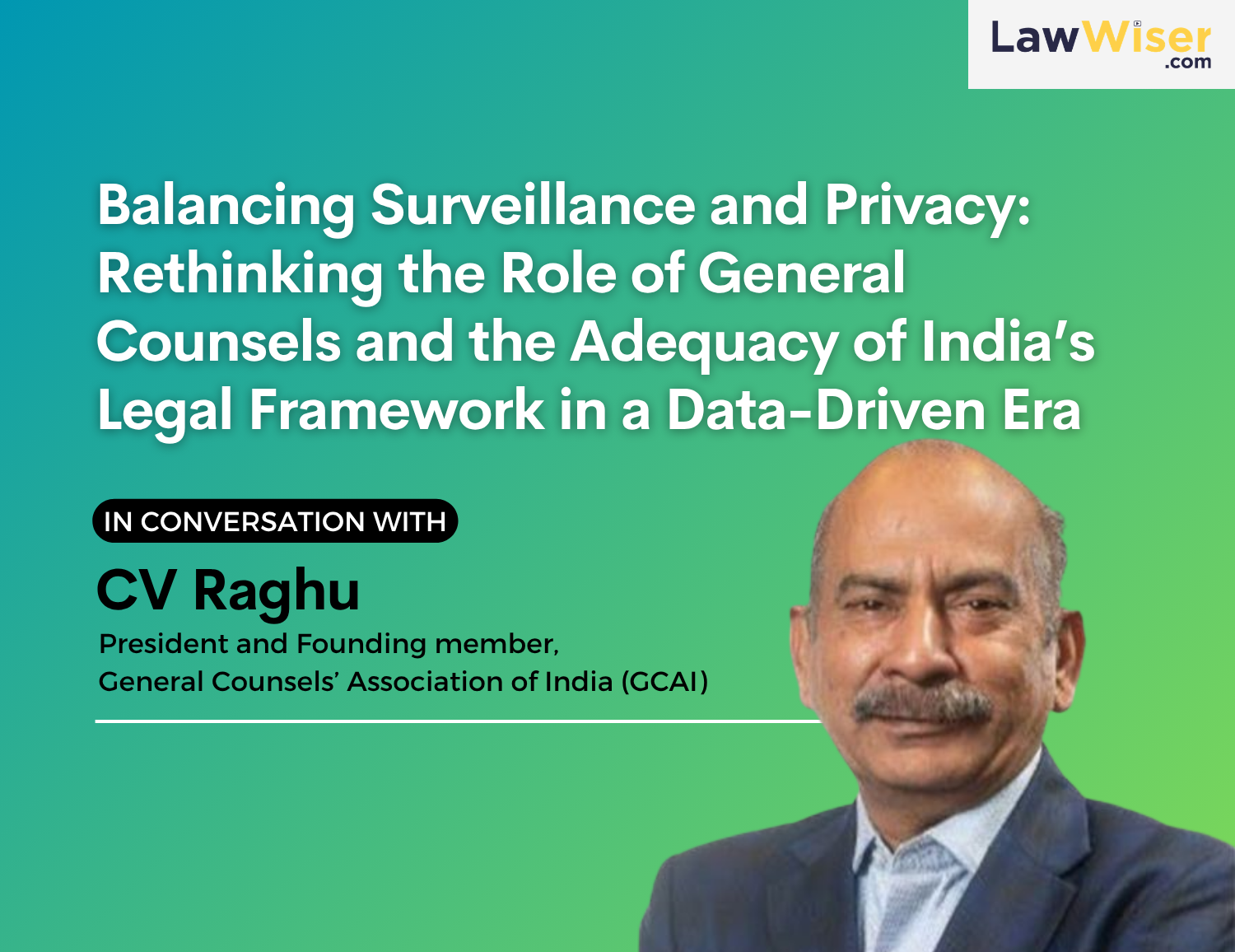
- Looking back at your experience, what is the one mindset shift young General Counsels need to make when dealing with data privacy and surveillance issues?
The most important mindset shift is from compliance to stewardship.
Data privacy today is not merely a legal obligation – it is a question of institutional trust and long-term credibility. Young General Counsels must recognise that their role extends beyond interpreting statutes to shaping how responsibly an organisation uses data.
Increasingly, General Counsels are moving into a central strategic position, interpreting global regulatory regimes, advising on AI and cross-border data flows, and designing enterprise-wide governance systems. In that context, the real question is no longer “Is this legally defensible?” but “Is this responsible, should we do this, and what does it mean for long term trust?”
- In high-pressure situations involving regulatory scrutiny or data breaches, what should be a General Counsel’s first instinct: protect, disclose, or investigate?
The first instinct must be to investigate swiftly and objectively.
In the absence of clear facts, both premature disclosure and excessive defensiveness can amplify risk. A structured fact-finding approach enables the organisation to respond with clarity and credibility.
Once the facts are established, the response must balance transparency with legal prudence. Regulators today expect accountability, not reaction. The sequence is critical: investigate, assess, and then act decisively.
- How can General Counsels effectively influence business teams that prioritise growth and data monetisation over privacy concerns?
General Counsels must reposition privacy as a strategic enabler of sustainable growth.
Governance quality today is directly linked to enterprise value, impacting customer trust, investor confidence, and market access. Data misuse can erode all three far more quickly than it can create short-term gains.
The role of the General Counsel is to design frameworks where growth and governance reinforce each other. By embedding privacy into product design and data strategy, legal teams can shift the narrative from restriction to competitive advantage. Influence comes not from saying “no,” but from shaping a smarter and more responsible “how.” The modern General Counsel is increasingly a business partner, not a gatekeeper – someone who helps the organisation grow responsibly, not restrictively.
- How should General Counsels approach conflicts between Indian regulations and global data protection standards in cross-border operations?
The approach must be anchored in globally aligned, interoperable governance systems.
As privacy regimes evolve, there is a clear convergence in regulatory expectations across jurisdictions. Enterprises must therefore build systems that can withstand global scrutiny—not merely satisfy local compliance requirements.
In practice, this often means aligning with the higher standard while ensuring adherence to domestic laws. The General Counsel’s role is to anticipate regulatory divergence, design adaptable frameworks, and embed compliance into the organisation’s operational and technological architecture from the outset.
The shift must be from reactive compliance to proactive governance. General Counsels are central to this transition, ensuring that compliance and ethical leadership are embedded into the organisation’s DNA, rather than treated as a post-facto safeguard.
- What skills beyond legal knowledge are critical for the next generation of General Counsels dealing with data, technology, and surveillance issues?
The next-generation General Counsel must be multi-disciplinary and business-aligned.
Beyond legal expertise, they need strong commercial awareness—understanding financials, regulatory trends, and business strategy. A working knowledge of technology, including AI, data governance, and vendor ecosystems, is now essential.
Equally important is the ability to interpret not just the letter, but the intent of the law, ensuring decisions align with broader ethical expectations. Emotional intelligence, particularly the ability to influence without authority and guide organisations through uncertainty, will be a defining trait.
Ultimately, those who combine legal acumen with business insight, integrity, and adaptability will emerge as true strategic leaders.
- If you were mentoring a young legal counsel today, what guiding principle would you give them to balance legal compliance, ethical responsibility, and business priorities?
I would advise them to anchor every decision in integrity without compromise.
Compliance is the baseline, not the benchmark. There will be situations where business urgency or senior leadership pressure may push for legally permissible but ethically questionable decisions. In such moments, a General Counsel must have the courage to take an independent and principled stand.
The function must be empowered with both authority and institutional support to do so. Without that independence, the role risks becoming one of validation rather than guidance. Long-term trust is built when legal leaders uphold principles, even when it is inconvenient. The real skill lies in finding solutions that are legally sound, ethically defensible, and commercially viable, without compromising long-term trust. That balance is what distinguishes a competent lawyer from a true leader.
- Are General Counsels today truly safeguarding privacy, or are they increasingly becoming enablers of aggressive data monetisation and surveillance strategies under the guise of legal compliance?
There is a visible tension, but also a clear transition underway.
In some organisations, the legal function is still viewed as a support role, which can risk reducing it to validating aggressive data strategies. However, that model is rapidly becoming obsolete. General Counsels today, especially in India, operate within one of the most complex regulatory environments globally, which has made them highly adaptive, commercially aware, and resilient.
The more evolved General Counsels recognise that their role is to act as guardians of institutional integrity. With increasing globalisation and alignment to international governance standards, the role is evolving into one of strategic leadership. The best General Counsels are not enabling what is merely permissible, they are defining what is responsible.
Ultimately, the role of the General Counsel is to act as the organisation’s conscience. Growth and data monetisation are important, but not at the cost of trust. Ultimately, sustainable enterprises will be those where the General Counsel has the conviction to say “no” when required—and the ability to guide the business toward responsible innovation.





 April 23, 2026
 0 COMMENTS