


 February 26, 2026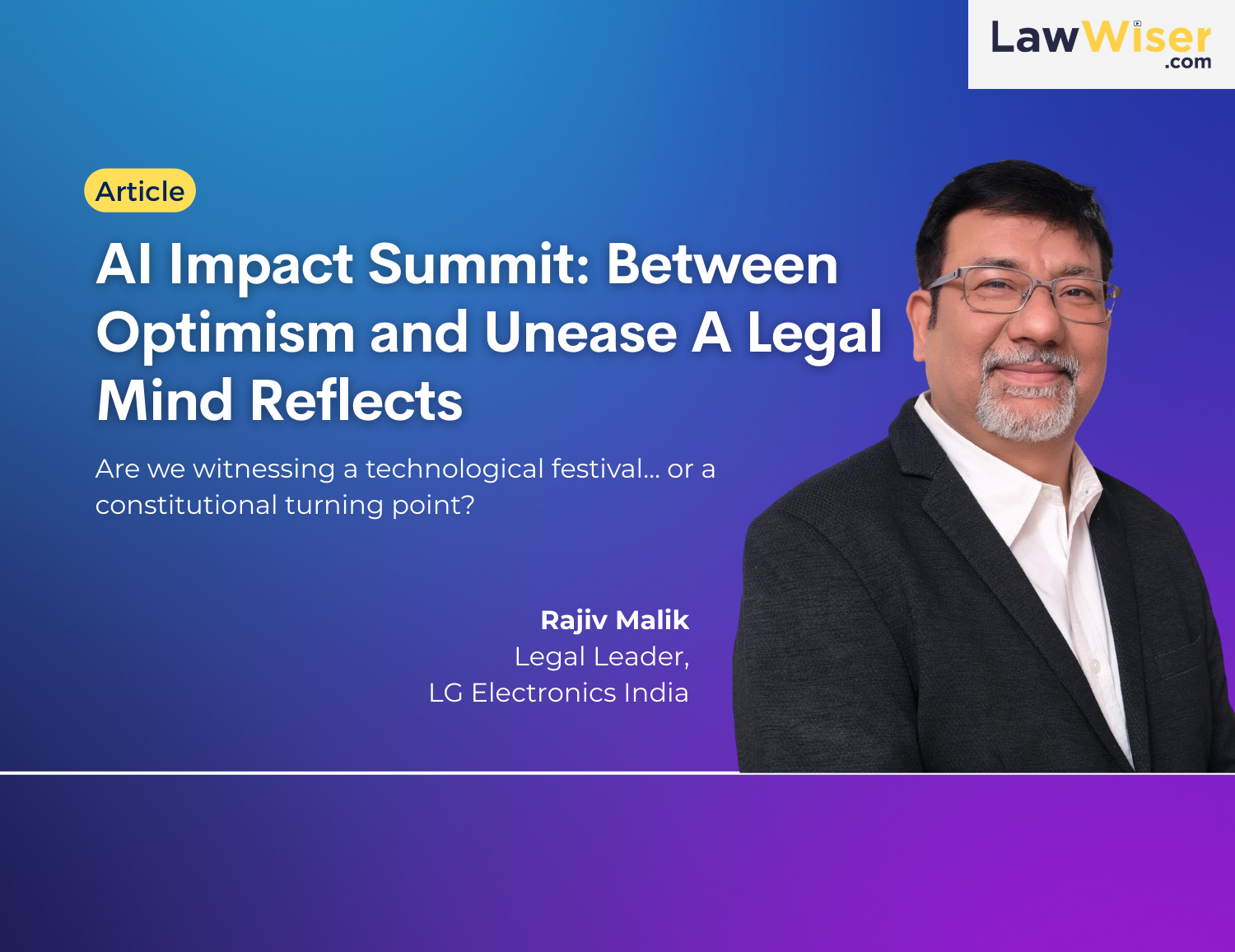
Are we witnessing a technological festival… or a constitutional turning point?
The recent AI Impact Summit in New Delhi felt less like a routine policy gathering and more like a moment of quiet assertion. India was not merely attending the global AI conversation; it was signalling that it intends to matter in it. Packed halls. Confident demonstrations. Policy optimism. The reassuring refrain — AI for all. But lawyers are trained to pause where others applaud.
AI for all… under whose rules? What safeguards? And at whose risk?
The Comfort of Optimism
Optimism, in periods of technological transition, often performs a stabilizing role. It builds confidence, attracts capital, and signals institutional readiness to embrace change. It creates the narrative that progress is both inevitable and beneficial. Yet legal experience teaches that early optimism rarely accounts for downstream consequences. Law intervenes not to resist innovation, but to ensure that its costs and risks are neither invisible nor unevenly distributed.
The message seems clear: AI will democratize access, improve productivity, and modernize governance.
Yet experience tempers enthusiasm.
We have lived through a similar arc with social media. Celebration came first. Commercialization followed. Regulation arrived much later, often after visible harm. AI is not simply another digital platform. It is the industrialization of cognition. It does not merely transmit information; it interprets, predicts, generates and increasingly influences decisions. That difference matters.
The Legal Profession: Disrupted, or Repositioned?
For lawyers, the debate is already outdated. AI is not coming. It is here.
Contract analytics. Litigation forecasting. Automated due diligence. Regulatory mapping. IP searches. Compliance dashboards.
Work that once required teams and time now takes minutes.
But the deeper shift is conceptual.
Large language models do more than retrieve information. They synthesise. They draft. They simulate reasoning. When platforms such as Anthropic’s Claude began demonstrating extended context capabilities, the IT and consulting ecosystem took notice. This was not a chatbot novelty. It was a system capable of analysing volumes of text at a scale previously unimaginable.
For law firms and in-house teams alike, the reaction oscillates between fascination and caution.
If AI drafts a contract, where does authorship sit?
If it fabricates a precedent, who carries liability?
If predictive tools influence litigation strategy, does human judgement subtly narrow?
The lawyer of tomorrow will not be replaced by AI, But the lawyer who does not understand AI may quietly lose relevance to one who does.
Governance: Spectator, Facilitator, or Architect?
The summit emphasised collaboration and voluntary commitments. That is encouraging. But voluntary norms are scaffolding. They are not foundations.Governance must evolve along three parallel tracks.
First, regulatory clarity without regulatory overreach. Excessive prescription could chill innovation. Absence of guardrails could entrench harm. Adaptive frameworks,regulatory sandboxes, and sector-specific oversight may prove more effective than sweeping declarations.
Second, data sovereignty and infrastructure depth. AI systems are only as sovereign as the infrastructure that sustains them. If models are trained elsewhere, hosted elsewhere, governed elsewhere, what precisely is domestic about their deployment?
India’s investment in data centres and indigenous capability is not technological vanity. It is strategic prudence.
Third, ethics beyond optics. Bias, misinformation, opaque decision-making, algorithmic discrimination — these are not academic concerns. They shape credit approvals, insurance underwriting, recruitment filters and potentially even public service delivery.
overnance cannot afford to be reactive. It must anticipate.
The Question of Work
Every technological transition unsettles labour markets before it stabilises them.
The uncomfortable possibility is that AI will compress layers of routine cognitive work. Entry-level research, drafting support, document review — these have traditionally formed the apprenticeship of legal practice.
What happens when that layer thins?
The answer is not resistance. It is redesign.
Legal education must move from memory testing to analytical judgement. Open-book examinations are no longer radical. They are realistic. Recall is abundant; discernment is scarce.
Future lawyers will need fluency in:
- AI-assisted research tools
- Algorithmic accountability
- Data protection regimes
- Cross-border technology compliance
- Model risk assessment
The profession will gradually shift from information custodians to strategic risk advisers.
AI and the Architecture of Power
There is a dimension we hesitate to articulate.
AI concentrates influence in those who control compute, data and model architecture. A small cluster of global corporations now shape how information is generated and filtered.
In a democracy, that concentration deserves scrutiny.
If governance systems integrate predictive tools, who audits the model?
If public decision-making relies on automated systems, who ensures fairness?
If generative AI accelerates misinformation, who safeguards electoral integrity?
Law, at its core, is about structuring and restraining power. AI amplifies capability. Their intersection will define the next decade of governance.
India’s Moment
India today is a vast consumer of AI tools, an expanding infrastructure hub, and a significant talent pool.
But consumption is not authorship.
Will India shape global AI norms, or adapt to those framed elsewhere?
The summit reflects aspiration. Implementation will determine influence. Indigenous research, credible public-private collaboration, embedded ethical design, and alignment with constitutional values will matter far more than slogans.
India possesses demographic energy, legal sophistication and digital scale. What it now requires is coherence — a strategy that aligns innovation with accountability.
A Closing Reflection
Optimism is valuable. Blindness is not.
AI is neither utopia nor catastrophe. It is an amplifier — of efficiency, inequality, insight and error.
For the legal community, this is not merely a new practice vertical. It is a structural reordering of how knowledge, responsibility and authority function.
We are not simply facing another industrial shift.
We are living through the industrialization of intelligence.
In such times, law cannot trail technology.
It must interrogate it. Shape it. And where necessary, restrain it.
The real question is not whether AI will reshape governance and the legal profession.
It already is.
The question that remains is quieter, but more important:
Will we shape it in return?
Rajiv Malik, Legal Leader, LG Electronics India – As an experienced Legal Counsel and sought-after speaker, He brings over 20 years of expertise in the legal field, specializing in litigation, contract management, Data Privacy, Anti-trust issues and compliance. Throughout his career, He has made significant contributions to the success of LG Electronics, where he has been instrumental in navigating complex legal challenges and ensuring legal compliance.






 March 18, 2026
 0 COMMENTS